
Your engineering team deploys a new feature Friday afternoon. Monday morning, your CFO is asking why the cloud cost spiked 40%. Welcome to “bill shock” and why FinOps has become essential.
Key Takeways
- Cloud computing brought speed and flexibility, but also complex costs, leading to “bill shock” for enterprises.
- This happened because IT fundamentally changed: from fixed CAPEX to variable OPEX, and spending control shifted to engineers.
- Cloud adoption introduced challenges like limited visibility, lack of control, resource waste (up to 30%), and misaligned goals between engineering, finance, and business teams.
- FinOps is a cultural practice and operational framework designed to maximize business value from the cloud by enabling data-driven decisions and creating financial accountability through collaboration.
- Key FinOps principles include collaboration, ownership, and data-driven decisions focused on business value.
- The framework involves domains, capabilities, iterative phases, and a maturity mode.
- A major challenge remains empowering engineers to act on optimization recommendations due to a lack of mandate, perceived risk, and unclear ownership.
- Ultimately, FinOps is about managing cloud spend effectively to realize the cloud’s full potential and align technology with business outcomes.
Introduction
Digital transformation has been and remains the main driver of the revolution in building and scaling digital services. Cloud computing brought speed and flexibility, but at the same time a new level of complexity – one that’s often hidden in plain sight: cloud costs.
To understand why FinOps has become relevant now, it’s essential to recognize how IT has fundamentally changed. Cloud computing changed how technology is acquired, consumed, and paid for, creating the conditions where a new operational framework was needed to manage cloud investment effectively, leading to the emergence of FinOps.
What has changed? Why now?
The Evolution of IT
The answer is simple: IT has changed. However, understanding the answer is not so simple.
Digital transformation has been around for quite some time now. Organizations have invested in infrastructure to support that transformation, so why has FinOps only now become relevant?
Public cloud has been around since 2006, so it took around 13 years for FinOps to appear. So, Cloud computing adoption is half the answer.
The initial cloud adopters were the small companies (startups and scaleups) since they didn’t have the money or the resources to have their own infrastructure. The size and frugal nature of small companies force them to be efficient in the way they manage their cloud costs.
Big companies (Enterprises) are the other half of the answer – they started to adopt the cloud. They did this by buying small companies or by building their own cloud capabilities to compete with other small companies in the same field. Most of the big companies adopted the “cloud first” approach, and some of them even adopted the approach “cloud all-in”, probably at a time when every company was saying that they were moving to the cloud (if everyone is moving to the cloud it must be a good thing, or if everyone is moving to the cloud I don’t want to be left behind).
Then, big companies were surprised by unexpected cloud bills – the bill shock. They were surprised because IT has changed.
From fixed cost to variable spending
In a data center, all the infrastructure investment is made up front (CAPEX, capital expenditure), while in the cloud, the infrastructure cost is dynamic (OPEX, operational expenditure).
From static to unpredictable
Cloud is a headache to the Finance team since the dynamic costs lead to unpredictability – having the cloud costs under control and within budget is a real challenge.
From procurement to engineers spending money
Finance and procurement teams are not the only ones that have a “company credit card” nowadays. Every engineer with the ability to create resources in the cloud is a potential spender.
From long procurement to instant spending
The moment that an engineer deploys a resource in the cloud, that resource gets charged (by time, storage, bandwidth,…) until it stops to exist. If the wrong resource is created, the creator cannot just go to the cloud provider and ask for their money back.
From conscious to experimentation
With the cloud, you don’t need to get it right on the first attempt. Experimentation became less expensive.
From slow to fast innovation
With experimentation, you get more innovation. The dynamic nature of the cloud provides you with the speed to innovate
Challenges That Emerged
Despite the clear benefits, cloud adoption brought some challenges to companies
Limited Visibility
There is no cost transparency. Cloud billing is complex, often spread across multiple services, accounts, and environments. Without proper tagging strategies and tools, it becomes difficult to answer questions like:
- Who is spending what?
- Which product or team is driving these costs?
- What types of cloud resources represent the higher costs?
This lack of transparency hinders timely decision-making and prevents accountability.
Lack of Control
In traditional IT, finance, and procurement departments had tight control over spending via procurement cycles. In the cloud, engineering teams can spin up resources with a credit card. While this brings agility, it also reduces centralized control. Organizations struggle to enforce policies or budgets, leading to overspending and financial unpredictability.
Waste of Resources
According to Gartner, about 30% of worldwide cloud spend is waste. One of the most common issues in cloud environments is underutilized or idle resources. Virtual machines left running after testing, oversized instances, or unattached storage volumes all contribute to wasted spend. Without continuous monitoring and optimization, this waste accumulates quietly and significantly.
Teams alignment
Engineering, finance, and business teams often have different goals and speak different “languages”.
- Engineers prioritize performance and uptime.
- Finance focuses on budget and forecasting.
- The business’s mission is to grow the business and the number of clients.
Each team has a different vision from the other teams:
- Engineering is seen as a siloed approach to technology.
- From a business perspective, IT is the department of limits, not of opportunities.
- Finance still sees IT through the traditional lens based on procurement, and struggles to keep up with the new consumption model of the cloud.
These different visions and misalignments lead to conflict or inefficiency when trying to balance cost and innovation.
Fear of using the cloud at scale
With the limited visibility and the lack of control, some organizations become overly cautious in growing their cloud adoption. This fear can lead to artificial constraints on cloud usage, inhibiting the very benefits the cloud is supposed to provide —flexibility and rapid innovation.
Bill Shock
Cloud costs can escalate quickly, especially with auto-scaling, data transfer fees, or pay-per-use services. Without guardrails, real-time alerts, or forecasting mechanisms, organizations often discover budget overruns too late, only in the monthly bill.
This “bill shock” not only causes financial strain but also makes companies re-evaluate their choice of going to the cloud.
What is the FinOps Framework?
According to the FinOps Foundation:
FinOps is an operational framework and cultural practice which maximizes the business value of cloud and technology, enables timely data-driven decision making, and creates financial accountability through collaboration between engineering, finance, and business teams.
The FinOps Framework from the FinOps Foundation provides the operating model for adopting FinOps as a practice.
My personal favorite definition is related to the cloud bill definition: cloud bill = rate x usage.
So, there are only two options to influence cloud spend: act on how much we pay for a resource (rate), or act on the type of resource that is deployed (usage).
FinOps Principles
The FinOps Principles guide how organizations should think about and implement cloud financial management practices. These principles emphasize collaboration, accountability, and agility.
Teams need to collaborate
Engineering, finance, and business teams must work together to make informed cloud spending decisions. Cross-functional collaboration ensures that everyone understands cost implications and contributes to optimization efforts.
Everyone takes ownership for their technology usage
Individual teams are responsible for the cost of the cloud resources they use. By empowering teams with cost visibility and accountability, organizations foster a culture of ownership and financial responsibility.
FinOps should be enabled centrally
A dedicated FinOps team acts as a hub, creating shared practices, tools, and governance. This team doesn’t control spending directly, but rather enables and educates others across the business. In other words, the FinOps team doesn’t do FinOps, instead enables the FinOps practice.
FinOps data should be accessible, timely, and accurate
Data must be available when it’s needed, where it’s needed, and should be accurate to support fast and good decisions. Delays in cost reporting reduce the ability to course-correct.
Business value drives technology decisions
Optimization isn’t just about cutting costs. It’s about maximizing the value delivered per dollar spent. This means making trade-offs between performance, speed, reliability, and cost based on business outcomes.
Take advantage of the variable cost model of the cloud
Cloud allows organizations to pay only for what they use, however, this requires actively managing resources. FinOps encourages flexibility, experimentation, and dynamic scaling while maintaining financial discipline.
FinOps Domains & Capabilities
The domains represent the business outcomes.
- Understand Usage & Cost: build shared visibility and understanding of cloud usage and cost across technical and business stakeholders.
- Quantify Business Value: maps cloud spend with business outcomes to ensure cloud investments are aligned with value delivery.
- Optimize Usage & Cost: improve cost-efficiency by reducing waste, using the right resources, and leveraging pricing models effectively.
- Manage the FinOps Practice: build and scale the FinOps practice as a cross-functional capability.
While each domain represents a strategic focus area, each FinOps capability is a specific set of practices or competencies that organizations should develop to mature their FinOps practice.
Understand Usage & Cost
- Data Ingestion
- Allocation
- Reporting & Analytics
- Anomaly Management
Quantify Business Value
- Planning & Estimating
- Forecasting
- Budgeting
- Benchmarking
- Unit Economics
Optimize Usage & Cost
- Architecting for Cloud
- Rate Optimization
- Workload Optimization
- Cloud Sustainability
- Licensing & SaaS
Manage the FinOps Practice
- FinOps Practice Operations
- Policy & Governance
- FinOps Assessment
- FinOps Tools & Services
- FinOps Education & Enablement
- Invoicing & Chargeback
- Onboarding Workloads
- Intersecting disciplines
FinOps Phases
The FinOps Framework is structured around three iterative phases that represent the lifecycle of cloud financial operations:
- Inform: achieve visibility, cost allocation, and shared understanding of cloud spend
- Optimize: identify inefficiencies and reduce unnecessary cloud spend
- Operate: embed FinOps into daily operations for continuous improvement.
FinOps Maturity Model

The maturity model provides a structured way for organizations to assess and evolve their FinOps practice. It helps teams understand where they are today, where they want to be, and how to get there across the capabilities within the FinOps domains.
Crawl
At the Crawl stage, organizations are just beginning their FinOps journey. They may be dealing with fragmented data, limited visibility, and ad hoc processes. The focus is on establishing basic awareness and building foundational capabilities.
Walk
In the Walk stage, organizations have started to formalize their FinOps practice. Teams have better visibility into cloud spend, more accurate cost attribution, and are beginning to collaborate regularly across engineering, finance, and business.
Run
At the Run stage, FinOps is fully embedded into organizational processes. All teams are cost-aware and empowered to make decisions. Optimization and financial accountability are continuous, real-time, and often automated.
Maturity is iterative and specific to each capability
Each FinOps capability can exist at a different maturity stage. For example, an organization might be in the “Run” stage for cost allocation but still “Crawling” when it comes to unit economics.
The goal of the maturity model is not perfection but progress. It helps teams to identify gaps and prioritize improvements in the most impactful areas.
FinOps Challenges
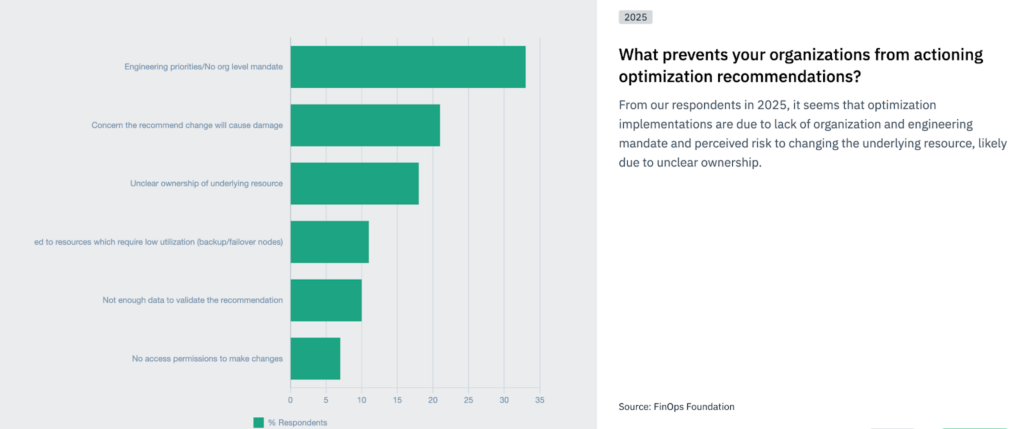
In 2025, according to the State of FinOps report, empowering engineers to take action remains a major challenge due to:
- Lack of organization and engineering mandate
- Perceived risk to changing the underlying resource
- Unclear ownership
Conclusion
As cloud adoption becomes pervasive, FinOps is no longer merely about cost reduction but about effectively managing the dynamic nature of cloud spending to maximize business value.
By fostering collaboration, accountability, visibility, and continuous optimization, FinOps provides the necessary structure and culture to navigate the complexities of cloud costs and fully realize the potential of cloud technology while aligning it with strategic business outcomes.
Overcoming remaining challenges, particularly the challenge of empowering engineers to act on optimization recommendations, will be key to further maturing FinOps practices and ensuring sustained financial discipline in the cloud.